
AI Filmmaking
The 1.5% Cut: Why AI Video Creation is Cinema's Next Great Art Form
Dissecting the metrics behind a 14-day, 60k-generation AI film at Cannes. Discover why prompt engineering and high-frequency AI rendering are transforming modern cinema.
 Jay Kilachand - CEOMay 29, 20265 min read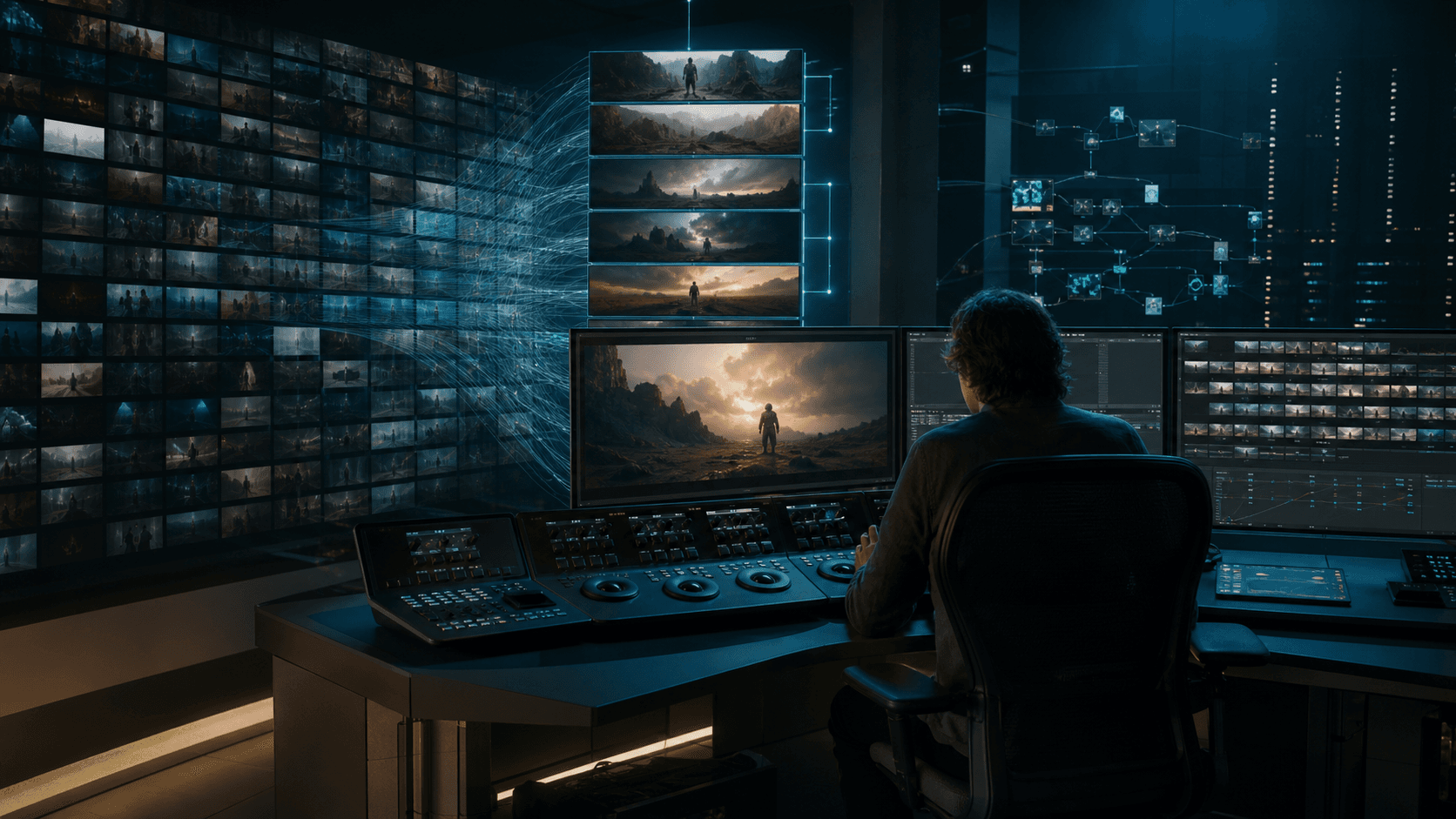
Summary
What this article covers
AI video creation is often mistaken for automation, but the hardest work is still human: direction, curation, iteration, taste, and the stamina to refine thousands of possible shots into a coherent film.
Key Takeaways
Direct answers
- AI video creation is not a press-button shortcut; it is a high-friction creative process built on human selection and judgment.
- The 1.5% creative funnel shows how much iteration, rejection, and curation goes into a polished AI film.
- As production budgets shift from physical logistics to compute, the creative advantage moves toward taste, stamina, and fluency with the models.
The 1.5% Cut: Why AI Video Creation is Cinema's Next Great Art Form
The traditional Hollywood machine is notoriously slow, massive, and expensive. The average major studio feature film takes anywhere from 1 to 3 years to produce and easily commands a budget of $65 million or more.
But a quiet revolution is happening in digital studios worldwide. Recently, a 95-minute feature film titled Hell Grind made headlines by proving what is possible at the absolute frontier of technology: it was produced in just 14 days for under $500,000, with roughly $400,000 of that budget allocated directly to raw compute power.
To the untrained eye, this looks like automated efficiency. Critics of generative AI love to claim that text-to-video tools remove the human element, reducing filmmaking to a simple "press button, receive movie" transaction.
They couldn't be more wrong.
When you look closely at the sheer volume of creative friction, meticulous curation, and technical mastery required to pull off a project of this scale, one truth becomes undeniable: AI video creation is not a shortcut. It is an art form.
The Illusion of Automation vs. The Reality of Friction
Let's break down the mechanics of what it actually takes to build a cohesive cinematic piece using cutting-edge workflows like Higgsfield Soul Cinema and ByteDance's Seedance 2.0.
1. Digital Sculpting: The 60,000-Generation Cutting Room Floor
During the creation of massive projects like Hell Grind, the volume of back-end generation is staggering. For the first few chapters alone, filmmakers pushed through 61,487 generations, which is part of an overall masterclass workflow requiring millions of compute credits.
Ultimately, only 960 of those generations made it into the final cut.
That is a conversion rate of roughly 1.5%.
Total Generations: 61,487 --> [ The 1.5% Creative Funnel ] --> Final Cut: 960 Shots
Think about that from a directorial standpoint. Traditional directors shoot multiple takes, but an AI director is sifting through tens of thousands of iterations, micro-adjusting seed values, altering lighting parameters, and battling algorithmic unpredictability to find the exact framing and texture that matches their creative vision. It is digital sculpting in its purest, most exhausting form.
2. Prompt Engineering as the New Screenwriting
There is a misconception that AI prompts are short, casual phrases. In high-end AI cinema, a prompt is not a sentence; it is an entire world-building manifesto.
To achieve the precise, hyper-tactile 15-second shots required for professional output, individual prompts ran as long as 3,000 words.
Writing a 3,000-word prompt for a single shot requires an intimate, masterclass understanding of:
- Cinematography: Specifying lens types like an Arri Alexa Mini LF with anamorphic primes, focal lengths, 180-degree shutter motion blur, and complex lighting configurations such as contre-jour backlighting to avoid the unnatural "AI sheen".
- Physics and motion: Guiding the model on fluid dynamics, fabric behavior, and anatomical accuracy during high-fidelity motion.
- Stylistic consistency: Coding the emotional and aesthetic DNA of the film into text so that disparate models can produce cohesive, interoperable footage.
This isn't just typing. It's directing through prose.
Shifting the Budget from Logistics to Imagination
In traditional Hollywood, millions of dollars are poured into the physical logistics of filmmaking: moving trucks, catering, permits, weather delays, and massive physical crews.
In AI filmmaking, the budget shifts entirely to where it matters most: the canvas.
Out of the $500,000 spent on a project like Hell Grind, $400,000 went straight to compute power via specialized cloud providers. The budget didn't go to managing traffic on a street corner in Los Angeles; it went toward rendering raw, unadulterated imagination. It is democratization through compute. It means a small, hyper-focused creative team can now wield the visual output of a legacy VFX house.
From the Fringe to Cannes and Global Demands
If you think this is restricted to tech-insider circles, look at the festival circuits. Hell Grind showcased its groundbreaking infrastructure during a side-screening event at the Cannes Film Festival's Marché du Film. Meanwhile, independent global platforms are embracing the medium fully.
The recent Higgsfield AI Filmmaking Competition drew a massive 8,752 film submissions from 139 countries, showing that the global creator community is moving lightning-fast. Interestingly, the data from the contest highlights a massive geographic shift in visual storytelling, with the highest volume of entries coming from India with 1,805 submissions, proving that regional creators are rapidly establishing themselves at the absolute frontier of generative entertainment.
The YBA Take: The New Creative Vanguard
At Young Bollywood Agency (YBA), we are constantly tracking the intersection of technology, culture, and storytelling. The rise of tools like Higgsfield Soul Cinema, Seedance 2.0, OpenAI's Sora, and Google's Veo aren't replacing filmmakers; they are liberating them.
We are entering an era where the barrier to entry is no longer the size of your studio bank account, but the depth of your taste, your stamina for curation, and your ability to speak the language of these models.
When only 1.5% of your work survives the edit, the human eye remains the ultimate arbiter of art. The machine provides the infinite canvas, but the artist still holds the brush.
What's your take on the future of AI in cinema?
Are we looking at a brand-new medium, or is it just an evolution of visual effects? Reach out to the YBA team to learn how we're integrating next-gen creative tech into our latest projects.
FAQ
Common questions
What does the 1.5% cut mean in AI video creation?
It refers to the small share of generated shots that survive the edit. In the example discussed here, 960 final shots came from 61,487 generations, making human curation central to the finished film.
Does AI video creation remove the human filmmaker?
No. AI video changes the tools, but the human filmmaker still defines the visual direction, writes the prompts, evaluates outputs, rejects weak takes, and decides what belongs in the final cut.
Why does compute matter so much in AI filmmaking?
Compute becomes part of the creative canvas because each iteration costs processing power. More compute gives filmmakers more room to explore, refine, and select the strongest images.